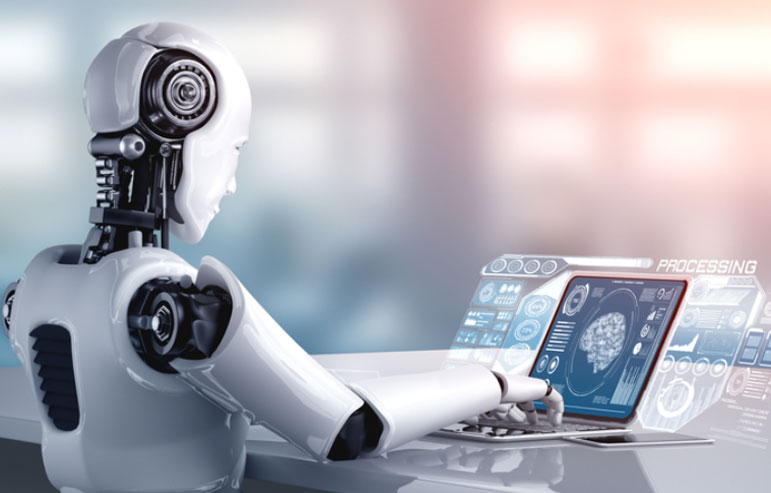
Artificial intelligence (AI) is the intelligence of machines or software, as opposed to the intelligence of humans or animals. It is a field of study in computer science that develops and studies intelligent machines. "AI" may also refer to the machines themselves.

Artificial Intelligence in BASIC presents some of the central ideas and practical applications of artificial intelligence (AI) using the BASIC programs. This eight-chapter book aims to explain these ideas of AI that can be used to produce programs on microcomputers. After providing an overview of the concept of AI, this book goes on examining the features and difficulties of a heuristic solution in a wide range of human problems. The discussion then shifts to the application of a heuristic solution to a two-ply search program for a two-person game. The following chapters are devoted to the other components of AI, including the expert systems, memory structure, pattern recognition, and language. The concluding chapter deals with the alternative and auxiliary approaches to the study of AI and its practical applications. Computer scientists and programmers will find this work invaluable.
Artificial intelligence (AI) refers to computer systems capable of performing complex tasks that historically only a human could do, such as reasoning, making decisions, or solving problems.
Today, the term “AI” describes a wide range of technologies that power many of the services and goods we use every day – from apps that recommend tv shows to chatbots that provide customer support in real time. But do all of these really constitute artificial intelligence as most of us envision it? And if not, then why do we use the term so often?
In this article, you’ll learn more about artificial intelligence, what it actually does, and different types of it. In the end, you’ll also learn about some of its benefits and dangers and explore flexible courses that can help you expand your knowledge of AI even further.
Knowledge representation and knowledge engineering[14] allow AI programs to answer questions intelligently and make deductions about real-world facts. Formal knowledge representations are used in content-based indexing and retrieval,[15] scene interpretation,[16] clinical decision support,[17] knowledge discovery (mining "interesting" and actionable inferences from large databases),[18] and other areas.[19]
A knowledge base is a body of knowledge represented in a form that can be used by a program. An ontology is the set of objects, relations, concepts, and properties used by a particular domain of knowledge.[20] Knowledge bases need to represent things such as: objects, properties, categories and relations between objects; [21] situations, events, states and time;[22] causes and effects;[23] knowledge about knowledge (what we know about what other people know);[24] default reasoning (things that humans assume are true until they are told differently and will remain true even when other facts are changing);[25] and many other aspects and domains of knowledge.
Among the most difficult problems in KR are: the breadth of commonsense knowledge (the set of atomic facts that the average person knows is enormous);[26] and the sub-symbolic form of most commonsense knowledge (much of what people know is not represented as "facts" or "statements" that they could express verbally).[13]
Knowledge acquisition is the difficult problem of obtaining knowledge for AI applications. Modern AI gathers knowledge by "scraping" the internet (including Wikipedia). The knowledge itself was collected by the volunteers and professionals who published the information (who may or may not have agreed to provide their work to AI companies).[29] This "crowd sourced" technique does not guarantee that the knowledge is correct or reliable. The knowledge of Large Language Models (such as ChatGPT) is highly unreliable -- it generates misinformation and falsehoods (known as "hallucinations"). Providing accurate knowledge for these modern AI applications is an unsolved problem.
AI automates repetitive learning and discovery through data. Instead of automating manual tasks, AI performs frequent, high-volume, computerized tasks. And it does so reliably and without fatigue. Of course, humans are still essential to set up the system and ask the right questions.

AI adds intelligence to existing products. Many products you already use will be improved with AI capabilities, much like Siri was added as a feature to a new generation of Apple products. Automation, conversational platforms, bots and smart machines can be combined with large amounts of data to improve many technologies. Upgrades at home and in the workplace, range from security intelligence and smart cams to investment analysis.
AI adapts through progressive learning algorithms to let the data do the programming. AI finds structure and regularities in data so that algorithms can acquire skills. Just as an algorithm can teach itself to play chess, it can teach itself what product to recommend next online. And the models adapt when given new data.
AI analyzes more and deeper data using neural networks that have many hidden layers. Building a fraud detection system with five hidden layers used to be impossible. All that has changed with incredible computer power and big data. You need lots of data to train deep learning models because they learn directly from the data.
AI achieves incredible accuracy through deep neural networks. For example, your interactions with Alexa and Google are all based on deep learning. And these products keep getting more accurate the more you use them. In the medical field, AI techniques from deep learning and object recognition can now be used to pinpoint cancer on medical images with improved accuracy.
AI gets the most out of data. When algorithms are self-learning, the data itself is an asset. The answers are in the data – you just have to apply AI to find them. Since the role of the data is now more important than ever, it can create a competitive advantage. If you have the best data in a competitive industry, even if everyone is applying similar techniques, the best data will win. But using that data to innovate responsibly requires trustworthy AI. And that means your AI systems should be ethical, equitable and sustainable